




Inside STS Aviation Services’ Global Base Maintenance Network
Aircraft base maintenance isn’t a commodity.
A routine maintenance check, structural repair, avionics modification, passenger-to-freighter conversion, lease transition and long-term storage program don’t ask the same things from an MRO facility.
The aircraft is different. The scope is different. The tooling is different. The people are different. The timeline usually is, too.
That’s why aircraft maintenance capacity means more than finding an open hangar door.
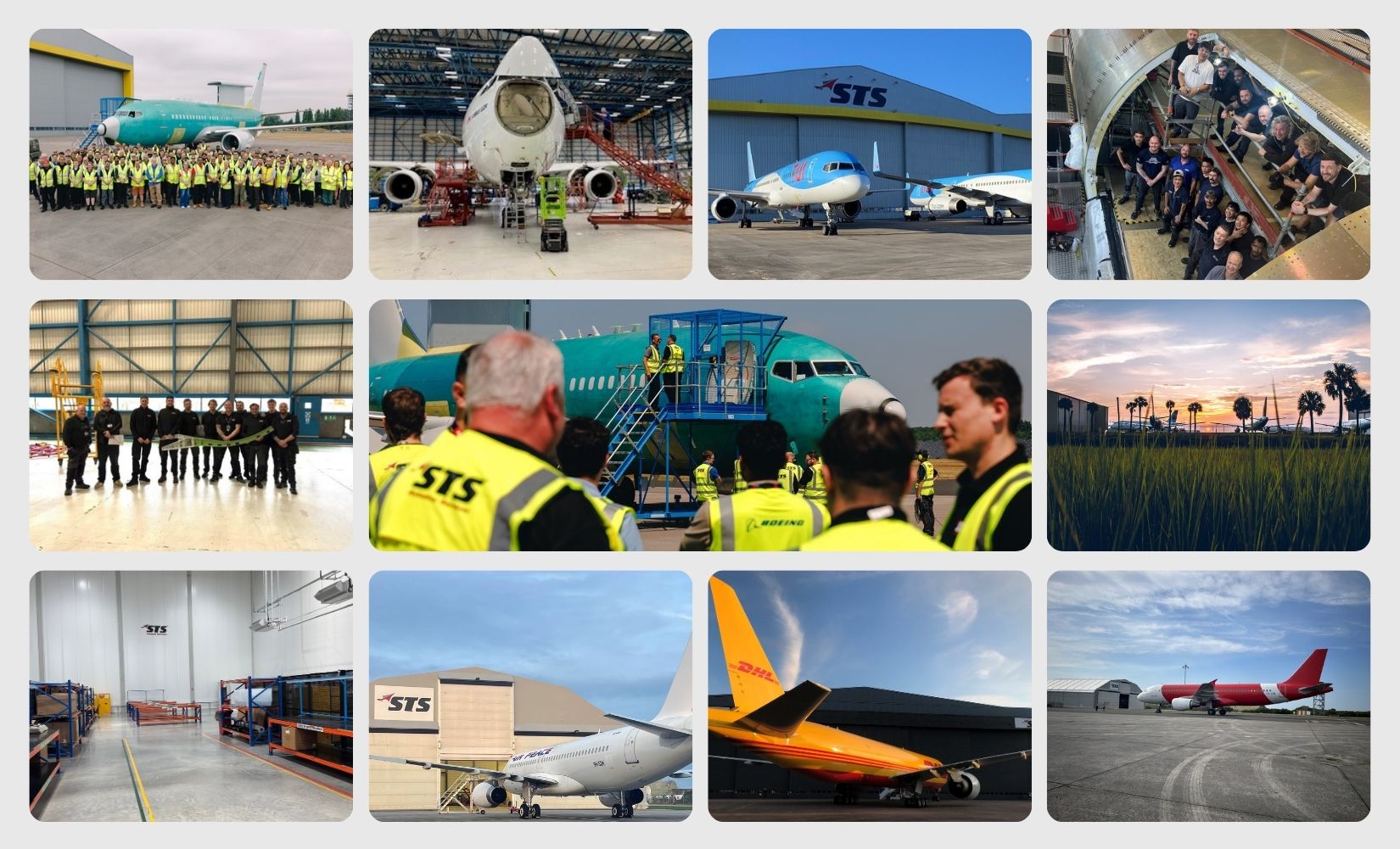
STS Aviation Services has built a global base maintenance network around that reality, with facilities in Melbourne, Florida; Birmingham, Manchester and Newquay in the United Kingdom; and Dubai, United Arab Emirates.
Each location brings its own infrastructure, technical strengths and operational capabilities to the larger STS MRO network. There’s overlap between them by design. There’s also specialization where it matters.
The result isn’t five versions of the same operation.
It’s a global network built to solve different aircraft maintenance problems.
Melbourne: Avionics, Structures and Complex Modifications
In Melbourne, Florida, STS Aviation Services operates more than 120,000 square feet of aircraft maintenance and modification space at Melbourne Orlando International Airport.
The facility combines aircraft maintenance technicians with avionics specialists, sheet metal and structural teams, inflight connectivity installation expertise and engineering support for complex modification requirements.
Capabilities include A and C checks, major and minor aircraft repairs, avionics installations and modifications, structural work, systems diagnostics, non-destructive testing, fiber optic installations, large radome installations and inflight connectivity programs.
That combination matters because modification work rarely stays inside one technical discipline.
An inflight connectivity installation, for example, can touch structures, avionics, wiring, testing, engineering and return-to-service requirements. When those capabilities exist within the same maintenance organization, the work becomes easier to coordinate and problems can be addressed without constantly handing the aircraft from one provider to another.
STS Aviation Services has completed thousands of aircraft connectivity installations across major commercial aircraft types, giving the organization experience with these programs at fleet scale.
Melbourne is built for that kind of work.
Manchester: Capacity for Heavy Maintenance and Major Programs
Manchester brings a different kind of scale.
Opened in 2022, the STS Aviation Services facility at Manchester Airport offers more than 245,000 square feet of working space, direct runway access and enough hangar capacity to support up to six narrow-body aircraft simultaneously.
Extensive front and rear access allows full circulation around the hangar, while dual apron access and dedicated technical and operational workspaces give maintenance teams room to manage large programs without forcing everything through the same physical bottleneck.
The work performed there stretches well beyond routine checks.
Manchester supports Boeing, Airbus, Embraer and Bombardier aircraft, along with major and minor repairs, structural modifications, sheet metal repairs, avionics work, inflight connectivity installations, systems diagnostics, entry-into-service programs and lease return support.
The facility is also home to STS Aviation Services’ work supporting the Mammoth Freighters Boeing 777 passenger-to-freighter conversion program.
That work involves a level of aircraft modification far beyond traditional scheduled maintenance and demonstrates the technical depth available at Manchester when an aircraft arrives with a particularly demanding scope.
That’s a useful measure of what major modification capability actually looks like.
Not a line on a capabilities sheet.
An aircraft in the hangar. A complicated program underway. A team responsible for executing it.
Birmingham: Heavy Maintenance Built for Complex Programs
STS Aviation Services’ Birmingham facility spans approximately 200,000 square feet at Birmingham Airport, with capacity to accommodate two wide-body aircraft or as many as ten narrow-body aircraft simultaneously.
The site is built to handle complex maintenance and modification programs at scale.
Integrated back shops, on-site component repair capabilities, vertical lift storage systems, mobile technical workstations and centralized reporting infrastructure allow teams to manage significant aircraft maintenance events under one roof.
Commercial capabilities include A and C checks, structural repairs, aircraft modification programs, engine changes, large component replacement, transition checks, entry-into-service projects, aircraft storage and flight support engineering.
Birmingham is also home to one of the most technically demanding programs in the STS Aviation Services portfolio.
Working alongside Boeing, STS supports conversion work on the United Kingdom’s E-7 Wedgetail AEW Mk1 program, transforming 737 Next Generation airframes into advanced airborne early warning and battle management aircraft.
The work requires extensive structural modification, systems integration and mission-specific upgrades.
That combination says a lot about the facility.
Birmingham can support traditional commercial maintenance while also executing highly specialized modification work where engineering complexity, program coordination and technical precision are critical.
For customers, that means access to a large-scale maintenance facility backed by teams accustomed to solving difficult aircraft problems, whether the aircraft arriving at the hangar is commercial or military.
Newquay: Supporting More of the Aircraft Lifecycle
Not every aircraft entering an MRO network needs to get back into scheduled service next Tuesday.
Some are transitioning between operators. Some are being stored. Some require preservation. Others are approaching teardown, recycling or another major point in their operational lifecycle.
That’s where Newquay becomes particularly valuable.
Located at Newquay Airport in Cornwall, the facility supports base and line maintenance, structural repairs, aircraft modifications, short- and long-term storage, preservation, teardown, recycling, AOG requirements, engine storage and preservation, and borescope inspections.
That gives airlines, lessors, OEMs and other aircraft owners options that extend beyond traditional scheduled maintenance.
Aircraft assets don’t spend their entire lives flying revenue schedules.
They move between owners. They wait for placements. They enter storage. They return from storage. They change configurations. They undergo repairs. Eventually, some leave service entirely.
Newquay gives STS the ability to support more of that lifecycle without treating every aircraft requirement like the same maintenance event.
Dubai: Expanding Base Maintenance Capacity in a Critical Aviation Market
Then there’s Dubai.
STS Aviation Services’ operation in the United Arab Emirates supports light and heavy aircraft maintenance across Airbus, Boeing and Embraer platforms, backed by more than 350 local team members supporting customers throughout the region.
The operation provides major and minor aircraft repairs, structural and sheet metal work, avionics installations and modifications, aircraft modification programs, inflight connectivity and IFE installations, cabin refurbishment, composite and paint repairs, entry-into-service work, lease return support and Service Bulletin and Airworthiness Directive compliance.
The Dubai team also supports more specialized requirements, including aircraft storage, teardown activity, pressure testing, tank entry, Airbus ACT support and AOG response.
That breadth matters.
Dubai sits inside one of the world’s most active aviation markets. Airlines, lessors, OEMs and other aircraft operators in the region need maintenance capacity close to where their fleets operate.
A local maintenance organization with growing capabilities changes the equation.
It reduces the need to move aircraft long distances for certain maintenance events and gives customers direct access to technical teams positioned within the region.
STS continues to invest in that capability.
In August 2026, STS Aviation Services received a GCAA CAR-145 C6 Equipment Rating at its Dubai CommerCity facility. The approval, issued under GCAA CAR-145 Approval Number UAE.145.0101, expanded the component maintenance work STS can perform locally in the United Arab Emirates.
For operators in the region, the significance is straightforward.
More capability. Closer to the aircraft.
Specialization Matters. Flexibility Matters More.
It’s easy to assign a label to each facility.
Melbourne does modifications.
Manchester does heavy maintenance.
Birmingham does complex programs.
Newquay does storage.
Dubai supports the region.
There’s truth in each statement, but none tells the full story.
Aircraft maintenance doesn’t fit neatly into boxes.
A C Check can uncover structural damage. A modification can create an engineering requirement. A lease transition can expose additional repairs. A connectivity installation can touch avionics, structures, wiring, certification and testing. A storage event can turn into a return-to-service program months later.
The real advantage of a base maintenance network isn’t rigid specialization.
It’s having enough specialization, capacity and technical overlap to respond when the scope changes.
Because it usually does.
One Maintenance Network. More Ways to Solve the Problem.
Look at the five facilities together and the larger proposition becomes clear.
Melbourne brings deep avionics, connectivity, engineering and structural modification experience.
Manchester adds significant hangar capacity and the infrastructure required for heavy maintenance and major aircraft conversion programs.
Birmingham combines commercial maintenance capability with experience executing highly complex structural and military modification work.
Newquay adds storage, preservation, transition and broader aircraft lifecycle support.
Dubai gives STS a growing maintenance platform in the United Arab Emirates with broad commercial aircraft capabilities and direct access to one of aviation’s most important regions.
But the value doesn’t stop at the hangar door.
STS Aviation Services operates within a larger organization that also supports aircraft operators through engineering, line maintenance, material services, component support, aircraft interiors, engine services, fuel system services and AOG response.
That becomes important when the original maintenance plan stops behaving like the original maintenance plan.
A maintenance team finds damage.
A required part becomes difficult to source.
Engineering support is needed.
Additional modifications get added to the work package.
The aircraft needs support somewhere else in the network after it leaves the hangar.
Those situations are easier to manage when more of the required expertise exists within the same organization.
The value of a larger MRO network isn’t that every maintenance problem disappears.
It’s that more of those problems can be solved without starting over with another provider.
Build the Maintenance Plan Around the Aircraft
Every maintenance event starts with a scope, a schedule and an aircraft that needs to return to service safely.
What happens after that depends on the work.
STS Aviation Services has built a global base maintenance network designed to give operators options when those requirements change, from scheduled checks and structural repairs to major modifications, avionics programs, aircraft transitions, storage and lifecycle support.
Five locations. Different strengths. Shared capabilities. One global MRO network behind them.
Because the goal was never to build the same hangar five times.
The goal is to have the right people, infrastructure and technical capability available when the aircraft arrives.
To learn more about STS Aviation Services’ global aircraft base maintenance capabilities, or to discuss an upcoming maintenance event, contact the STS Aviation Group MRO team.